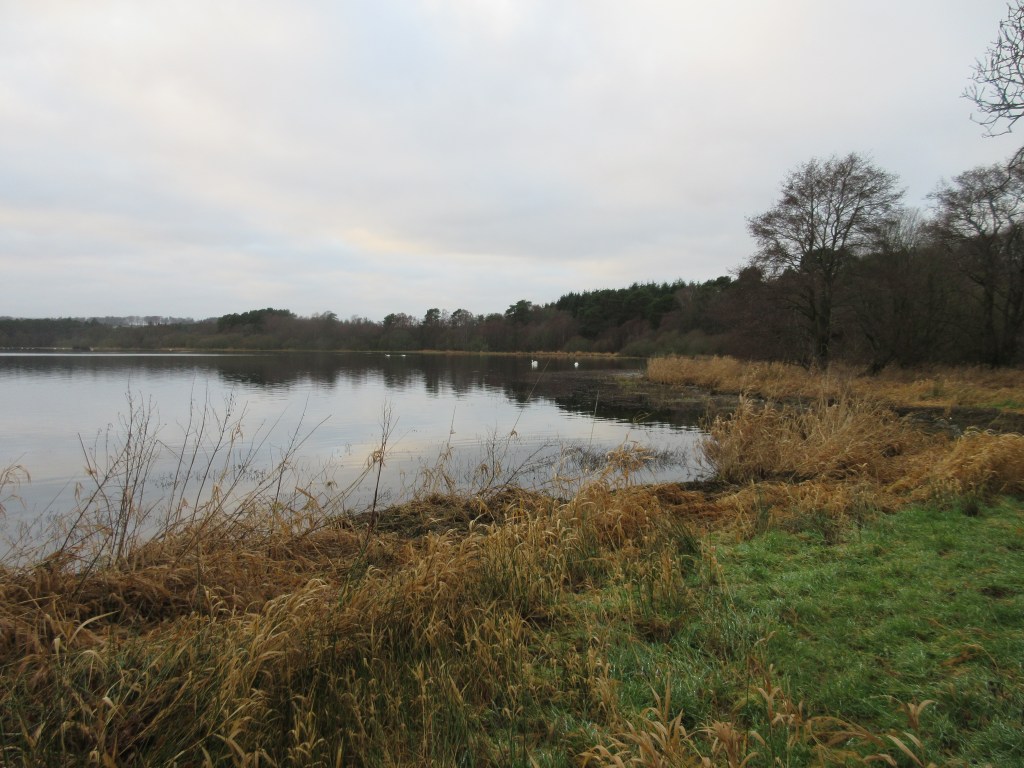
Winter is often the time when I stay close to home and explore the burn that runs behind my garden. Ten or so years ago a fish ladder was installed just a few hundred yards downstream to allow salmon to migrate upstream through the often tree shaded waters of Leuchar Burn to Loch of Skene with its wintering geese and windfowl, before finding their way up to headwaters on the flanks of the Hill of Fare. Wherever trees line the banks, their heavy lichen cover looks like winter blossom. Those trees, and the lichens and mosses that grow on, and below, them, absorb rainwater and thus help ameliorate flooding further downstream. As is the case for the salmon, this river and wood ecosystem forms an important corridor for the dispersal of lichens and mosses. It often strikes me how we emphasise the functional role of riverwoods. Exploring the riparian woodland around Loch of Skene this winter afternoon, I wonder whether these woods also have value in themselves.
Riverwoods, riparian woodland, waterside forests – different terms to describe those woodlands and individual trees that line water bodies like rivers, burns and lochs. Within the watershed of the river Dee, Loch of Skene takes in a relative lowland position and forms a bead along a chain that has its source on the Hill of Fare and eventually feeds into the main river. Whereas the Dee is a nutrient poor upland river, the Leuchar Burn that drains Loch of Skene is more nutrient rich, in turn adding nutrients to the Dee itself.
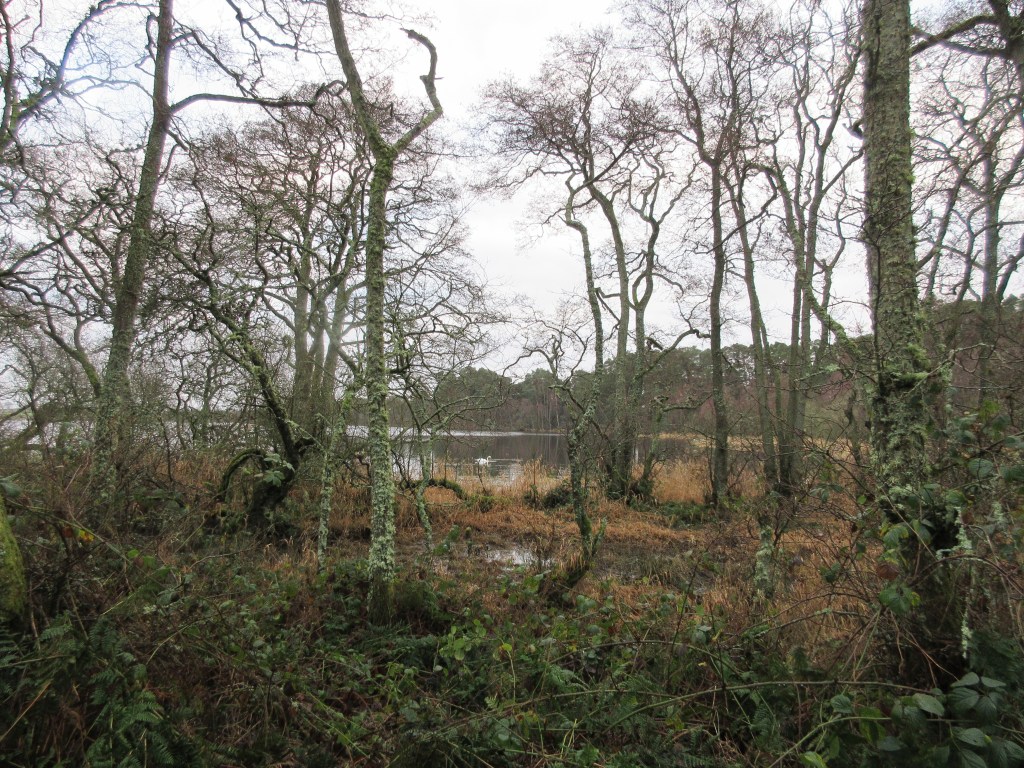
Though it is a dry winter day, the air is damp and chilly. Approaching the loch, I walk through wet birch and pine woodlands before I reach the even wetter alder and willow woodlands on the shores of the loch. Here, much of the ground is sodden. Sphagnum and Polytrichum commune hummocks rise amongst pools that are arched by leaning trunks and boughs. Without leaves on the trees, the green zone of mosses on the ground and the more humid layer just above the water stands out clearly against the grey zone of lichens that dominates the upper parts of the trunks and the crowns of the gnarly trees. The wetter the ground, the more riotous the trees that try to stand firm. Those areas most liable to flooding in winter are a mishmash of trunks leaning at different angles and trees that have been uprooted altogether. Mature dry woodland has a regular, closed canopy, lochside woods have a much more varied canopy that lets through ample light.
The riparian woodlands along Loch of Skene and the Leuchar Burn that connects the loch and the river Dee sits within a wider landscape of conifer plantations, most of which are clearfelled on rotation or fell victim to severe storms several years ago. The patterns of disturbance in riparian woodland is different. Not only are the gaps opened up much smaller, the trunks of trees like willow have the ability to produce new shoots and form new trees, thus occupying those opened up spaces rapidly. As a result, riverwoods see a high degree of ecological continuity and that may benefit species that are dependent on old growth woodland. Rather than seeing the woodlands that line rivers and burns as dispersal corridors, this suggests that riverwoods can also function as refugia for lichen and bryophyte species that are dependent on continuity of the woodland canopy.
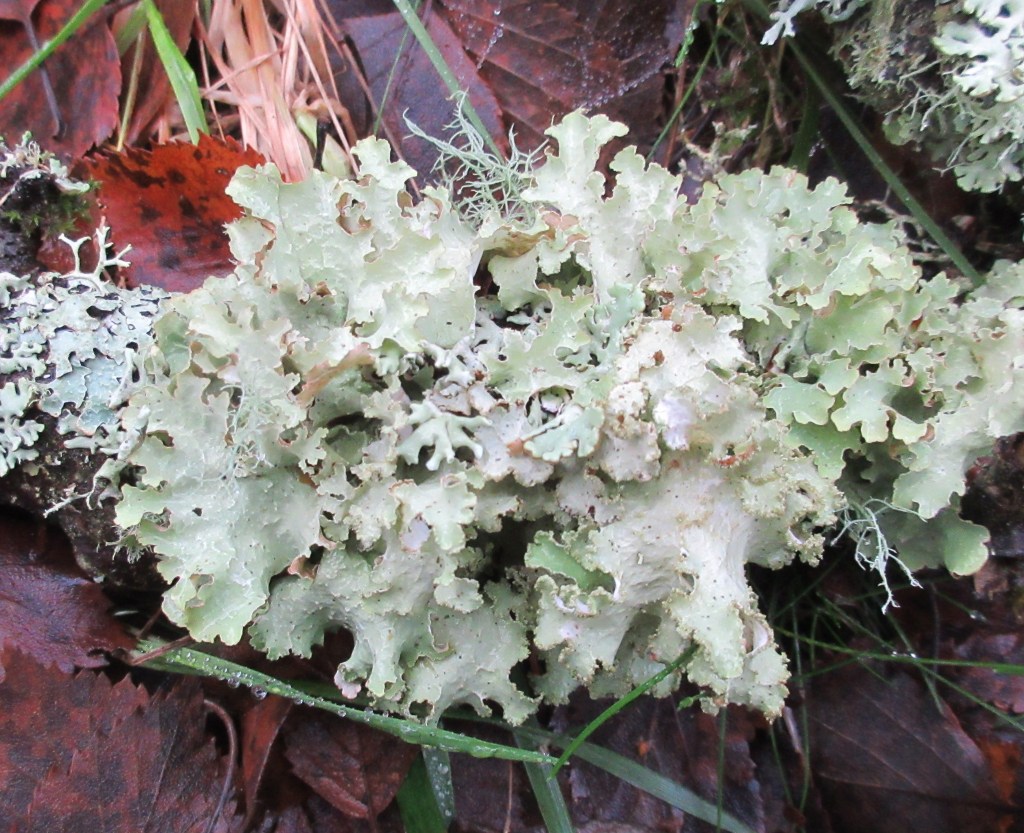
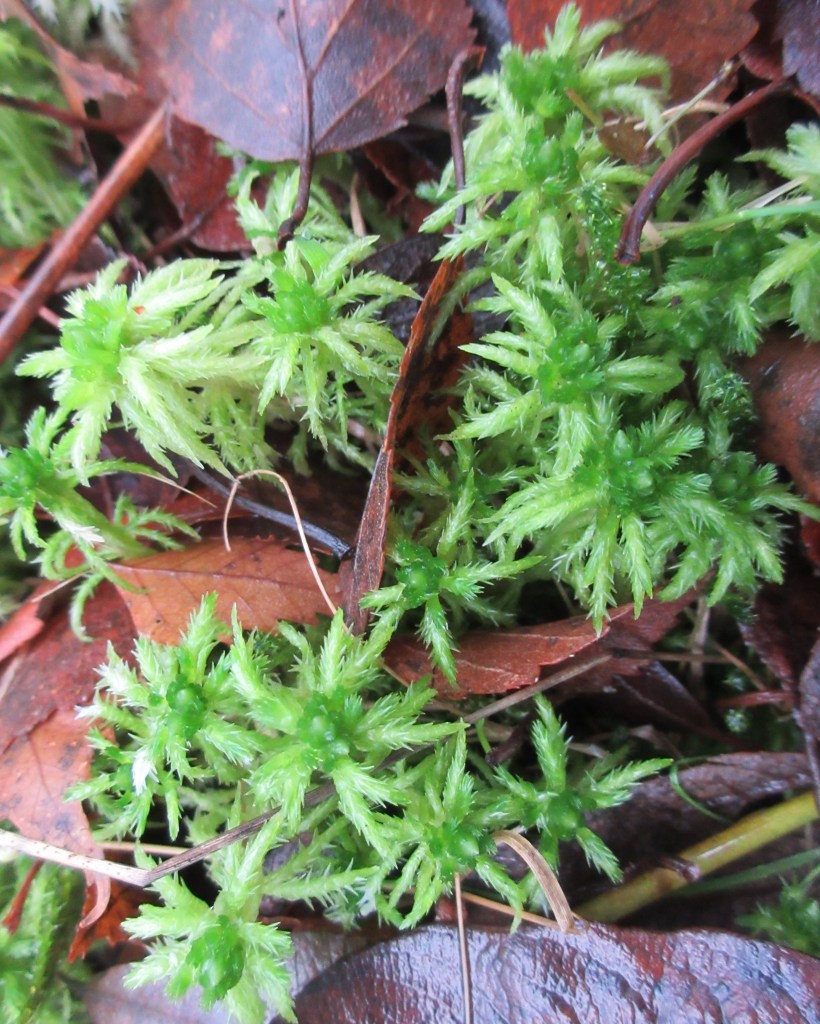
As I walk along I take note of some of the species I see. The common Evernia prunastri, Platismatia glauca and Usnea subfloridana are abundant, but there is also Usnea dasopoga, a species for which there are few local records. I kneel down to take photos of some of the bog mosses and notice I have found Sphagnum squarrosum, another species that I do not see regularly. Riverwoods are indeed refugia for species that are on the edge of their range and that require both ecological continuity and the more humid conditions provided by riverwoods. But refugia are pockets of high quality habitat within a landscape with similar habitat that is of less quality. As I explore the lochside woods, I wonder whether these woods can be seen as valuable in their own right as well.
After lunch a few days ago, I went to look at the bole of an uprooted tree along Leuchar Burn and found it covered in extensive mats of Porella cordaeana. A few months earlier I had found this species on a boulder in the Coy Burn at Crathes Castle and Estate, but it is uncommon enough to remember the exact locations of these finds. Like other aquatic mosses and liverworts, this species is found on boulders in burns as well as on tree boles along those waters. Few, if any, aquatic lichens are able to do the same. Looking at the vertical zonation of bryophytes and lichens in riparian woodland, this makes sense. The conditions on the boulders in the burn and the upper parts of the trees are simply too different. Lower down the trunk faster growing bryophytes have the competitive edge, outcompeting the more stress tolerant lichens to the slightly drier upper parts of the tree.
I hear a skein of geese flying over while my eyes rest on a pair of swans framed by an opening in the trees. Riverwoods are not only dispersal corridors or refugia for species, but they are also unique in their own right. The riot of trunks, boughs and branches cushioned by mosses and clad in lichens provides a high degree of structural diversity, a much higher degree than the birchwoods and conifer plantations that surround it provide. It is this structural diversity that, within the overall damper climate of riverwoods, generates a diversity of niches and microclimates that encourages lichen and bryophyte diversity.
If you are interested in learning more about lichens on trees and riparian woodland lichens, there are several opportunities coming up:
- On 16 January 2026 I will deliver a Biodiversity Short on Riparian Woodland Lichens for the Field Studies Council.
- The next start dates for the distance learning course Lichens on Trees is 23 March and 18 May 2026.
Copyright text and images Petra Vergunst
 scottishlichens.co.uk