
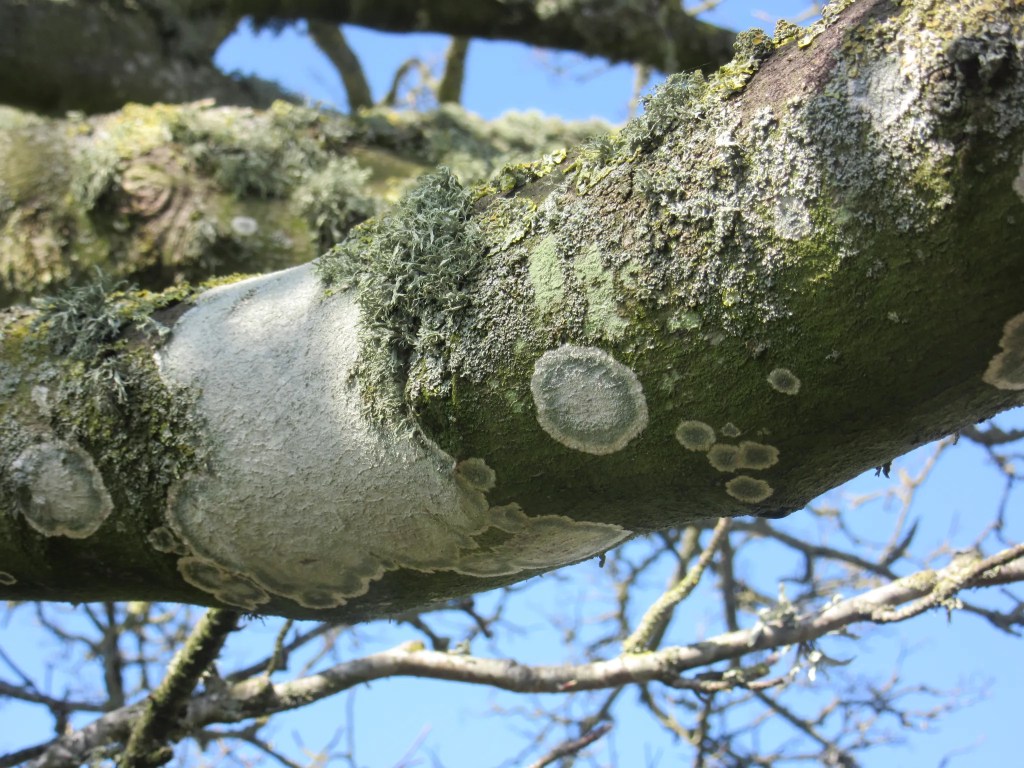
Earlier this summer I visited a Sunhoney Stone Circle near Echt in Aberdeenshire and, as yet another shower caught up with me, I took shelter underneath a nearby broad branched sycamore to let the worst of the rain pass by. As summer progressed, the leaves had darkened and the lower boughs were in deep shade. I had to duck down to reach a sheltered spot. When I stood right up again I realised the bark was covered in Xanthoria parietina, a lichen that is yellow in the sun but greenish grey when growing in shade. The bottom of the branches had the characteristic whitish green crusts of Phlyctis argena. And then I noticed the Ramalina fraxinea, old and weathered as the tree, with Physcia tenella growing on it, diminutive in comparison.

If you’ve ever marvelled at lichens that grow on the trunks, branches and twigs of trees, and wanted to learn more about what these lichens represent, and why they’ve chosen a tree to grow on, the distance learning course Lichens on Trees may be for you. This course introduces you to the lichen symbiosis, how lichens function and the interaction between lichens and trees. You will also learn why different tree species attract different lichen species, and how they reproduce and seek new spaces to grow on. And this, in turn, will help to understand the responses of lichens to environmental change, including climate change.
This distance learning course is structured around five topics that each involve reading, fieldwork activities, critical reflection, and is rounded off with a course submission for which you will receive feedback. Participants are encouraged to shape the course around their own interests and there is opportunity within the course to discuss your own course related interests. The course lasts ten weeks, but within that period, you can pace the coursework yourself. As such, this course is ideal for anyone who would like to learn more about lichens – rangers, ecologists, environmental surveyors, tree surgeons, foresters, woodland and reserve managers, volunteers, students and anyone else working in the woodland and nature conservation sector, and, of course, people with a more general interest in natural history. Though written from a Scottish perspective, the course covers species that are commonly found in Britain and Ireland whilst also highlighting species with a more regional distribution.
The course is delivered by Petra Vergunst through Scottish Lichens. With a background in forestry and nature conservation, she works as an ecologist with a special interest in lichens and bryophytes, and has extensive experience in delivering training in these subjects, both online and in person.
The next start date for Lichens on Trees will be Monday 28 September 2026.
More information on the course can be found on the website Scottish Lichens.
You can sign up for the course through Eventbrite.
Copyright text and images Petra Vergunst

