Earlier this spring I returned to the Highland Wildlife Park to deliver a number of lichen tours for staff. The lichen survey that would feed into the park’s biodiversity plan I had done the previous year had been a welcome way to continue some of my thinking about the interactions between lichens and animals.. At the time, I was still thinking of the lichens on the cliffs of the seabird colony at the RSPB reserve of Fowlsheugh that had shown significant influences of hypertrophication. Now, during the staff tours, we would be discussing another type of interaction between lichens and animals: lichen herbivory.
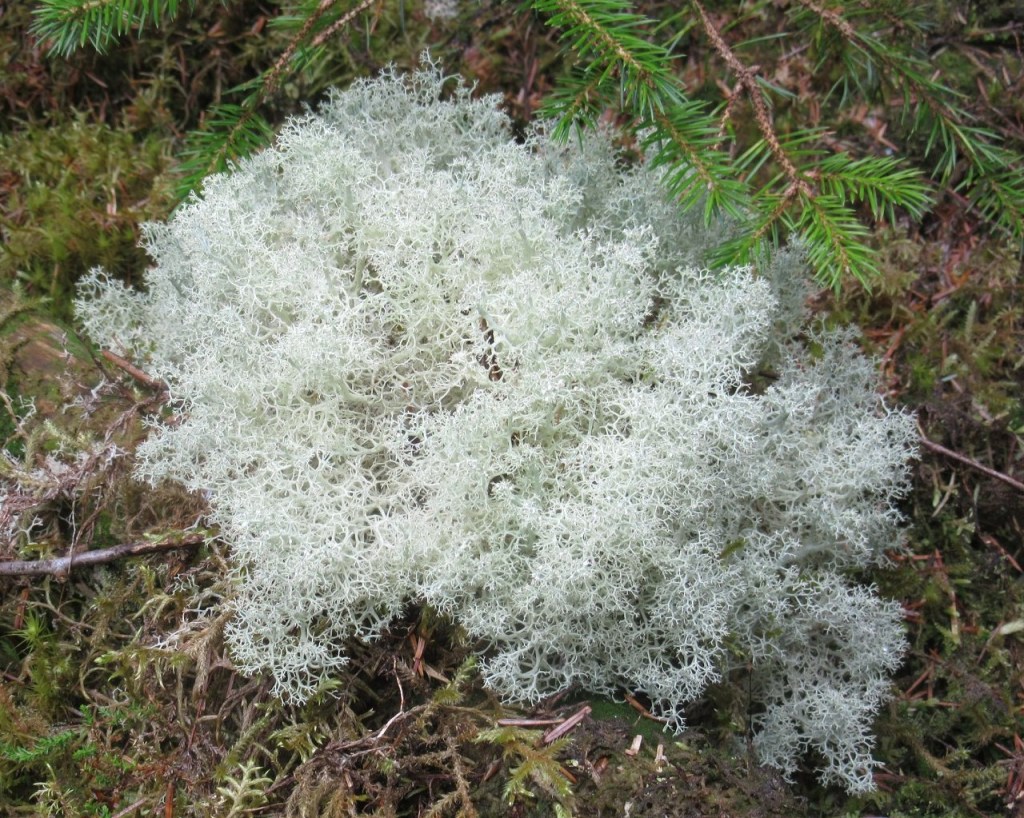
Though the Cladonia species they eat are, rather confusingly, often spoken about as reindeer moss, lichens form an important, and preferred, part of the winter diet of reindeer. The low cellulose and lignin contents make lichens particularly palatable to reindeer, and their richness in soluble carbohydrates makes them an important source of energy in winter. As large mammals with hooves, it is their rumen and bacterial flora that enables reindeer to break down this lichen carbohydrate. Caribou, the reindeer that live in America, eat, amongst other species, the terrestrial reindeer lichens Cladonia stellaris and Cladonia rangiferina as well as Stereocaulon species, which they find by kicking holes in the snow. In wooded areas caribou will mainly feed on tree lichens of the genera Alectoria and Bryoria, but they may also forage on Hypogymnia physodes, Tuckermannopsis ciliaris and even Lobaria pulmonaria.

The grazing pressure of semi-domesticated reindeer on lichen can be high, especially where their seasonal migrations are restricted. Though reindeer can eat grasses and mosses as well, they have been found to overgraze and deplete local lichen stocks. Had reindeer not been semi-domesticated, it would have been less likely that they would have overgrazed the lichens in their territory as their population would have been controlled by the food that is available to them. But the presence of reindeer may have a positive impact on lichens as well. Some of the mat-forming Cladonia species eaten by reindeer disperse through fragmentation. Cladonia uncialis subsp. biuncialis, for example, nicknamed the macaroni lichen, easily breaks into bits when put pressure on. So while reindeer are grazing, they will at the same time trample these mat-forming Cladonia species and contribute to their rejuvenation and dispersal.
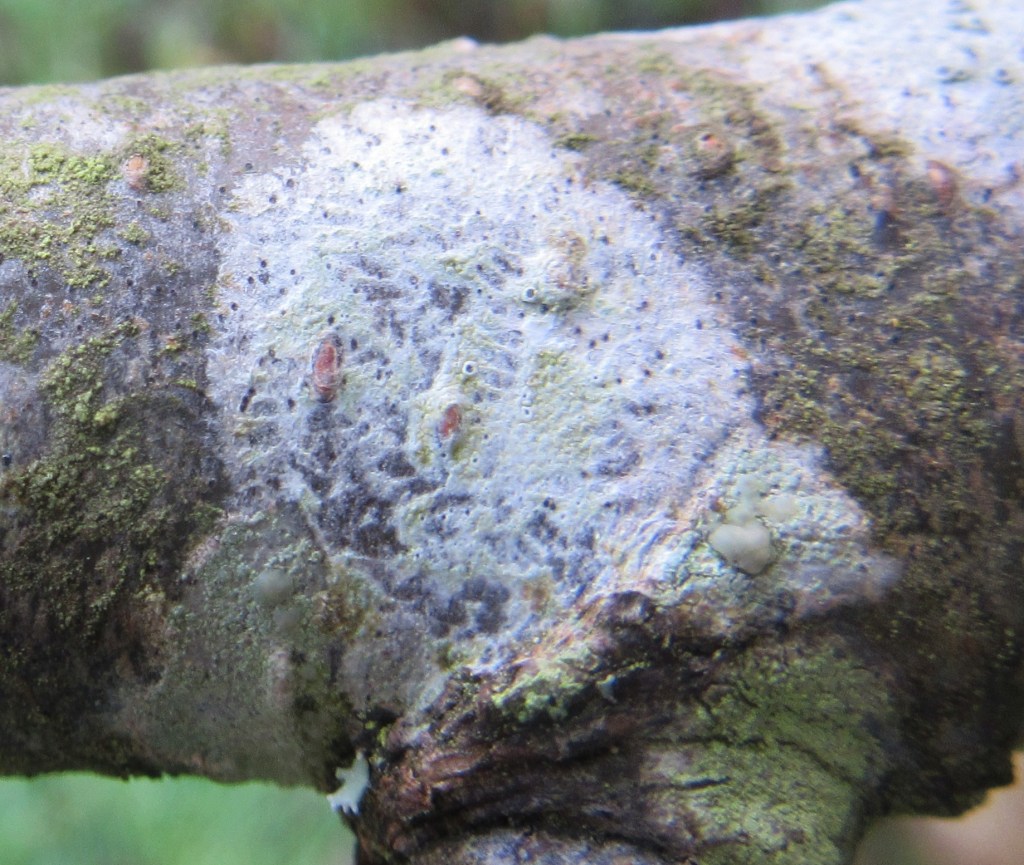
But you don’t have to travel to high latitudes to find examples of lichen herbivory. When looking at crustose lichens on the trunks and branches of trees, many of us will have encountered crusts that seem to be covered in zigzag patterns or crusts in which apothecia have quite mysteriously been replaced by holes. These are the tell-tale signs of grazing by slugs and snails. Doing so under the cover of darkness, slugs and snails will scrape the thallus, leaving parallel scratch marks, with the zigzag patterns pointing out the side to side movements their mouths make. On limestone pavement the herbivory by slugs and snails can be so intense that lichens that usually form a crust on top of the rock develop an immersed thallus. Some lichens, however, have developed a chemical defence mechanisms in the form of lichen substances to make themselves less palatable. Ramalina siliquosa, a characteristic lichen of rocky shores, has developed at least four so-called chemotypes, each producing unique lichen substances that deter different species of mites from taking a nibble.

Sometimes, it is conversations with others and the exchange of experiences that help us take a closer look at our understanding of a topic. My conversations with staff of the Highland Wildlife Park have certainly helped me to place my understanding of lichen-animal interactions and lichen herbivory in a wider context. As primary producers lichens are at the bottom of the foodweb along with vascular plants and bryophytes. Though species interactions within the foodweb are usually balanced, human intervention may tip the balance and lead to overgrazing. Lichens, however, have adapted to withstand herbivory through chemical means. What’s more, some species have made a virtue out of it by using thallus fragmentation as a dispersal strategy. Even those spores that pass through the digestive system of slugs and snails are thought to remain viable.
Sources
Brodo, I. M., S. D. Sharnoff and S. Sharnoff, 2001. Lichens of North America. Yale University Press, New Haven and London.
Dobson, F. S., 2018. Lichens. An illustrated guide to the British and Irish species. The Richmond Publishing Co. Ltd.. Seventh revised edition.
Gilbert, O., 2000. Lichens. HarperCollinsPublishers, London.
Kijola, I. et al, 1995. Effects of lichen biomass on winter diet, body mass and reproduction of semi-domesticated reindeer Rangifer t. tarandus in Finland. Wildlife Biology 1(1): 33-38.
Copyright text and images Petra Vergunst
 scottishlichens.co.uk
One thought on “Lichen herbivory: on the trail of reindeer and slugs”