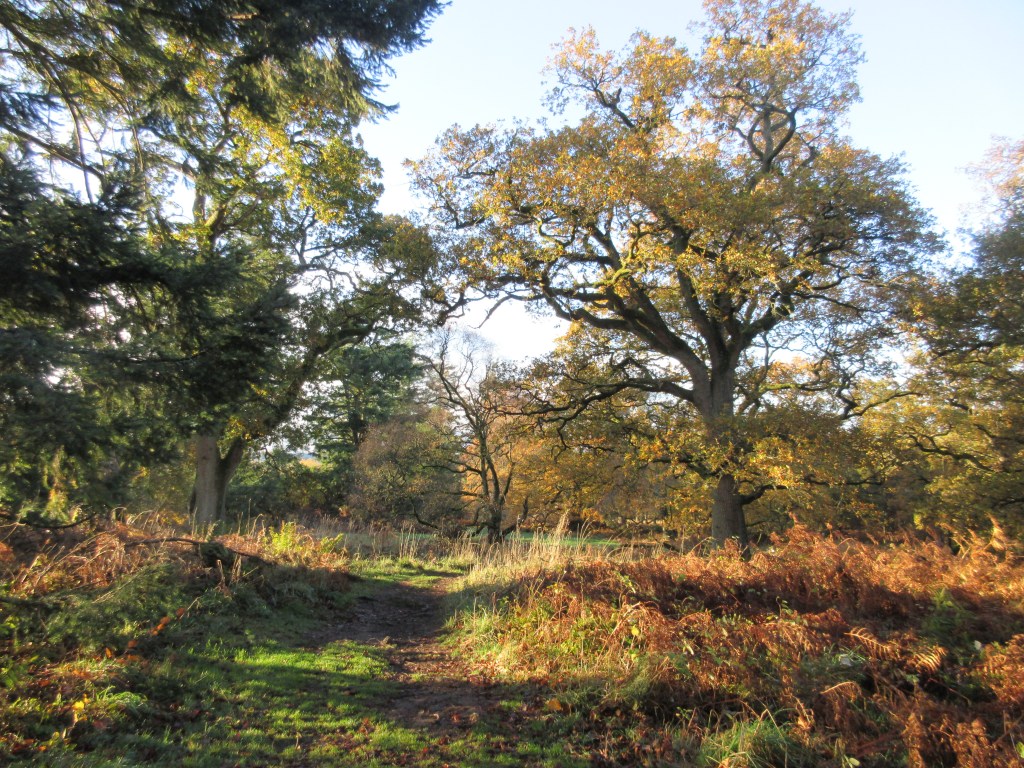
On a cold winter’s day the veteran oak trees in the Old Wood of Drum (National Trust for Scotland) in Aberdeenshire look magnificent. Bared of all leaves, the lichens that cover trunks and branches become even more prominent. What appear to be streaks of yellow paint turn out to be the powdery looking lichen Chrysothrix candelaris. The lilac hue on neighbouring trees reveals itself as the dusty looking Lecanactis abietina littered with spore-bearing structures.
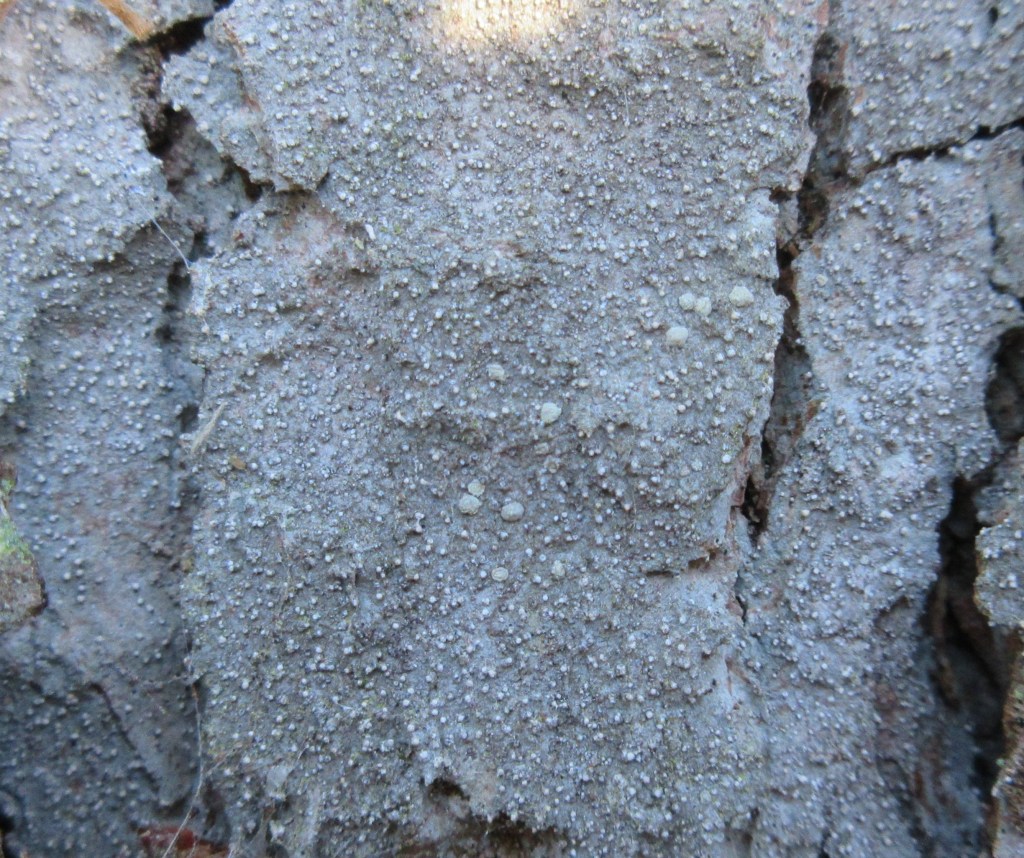
Some lichens are highly visible, others not so. Most of the trees, however, have a significant lichen cover. But the term lichen is misleading as it implies a single organism, whereas what we are looking at is a composite organism comprising a species of fungus and – here in the Old Wood of Drum – a species of green algae. The alternative name for lichen – lichenised fungi – suits better as it points out that we are looking at a fungus species that uses lichenisation as a nutritional strategy. Let’s wind back a few months and imagine the Old Wood of Drum in autumn. There are fungi everywhere. Those on the ground will mainly be mycorrhizal fungi that help the tree access nutrients and water from the soil in return for energy that the oak derives through photosynthesis. Those fungi fruiting bodies that emerge on living oak trees will be parasitic and derive their energy by weakening or killing the tree. Among the wide-crowned oaks lie some impressive logs which are slowly decomposed by saprobic fungi. Lichenised fungi grow on trees as well and they derive their energy through photosynthesis by the green algae they live in symbiosis with. The tree, for them, is merely a substratum they anchor to, not a source of energy. Lichens are not parasitic, they are epiphytic.
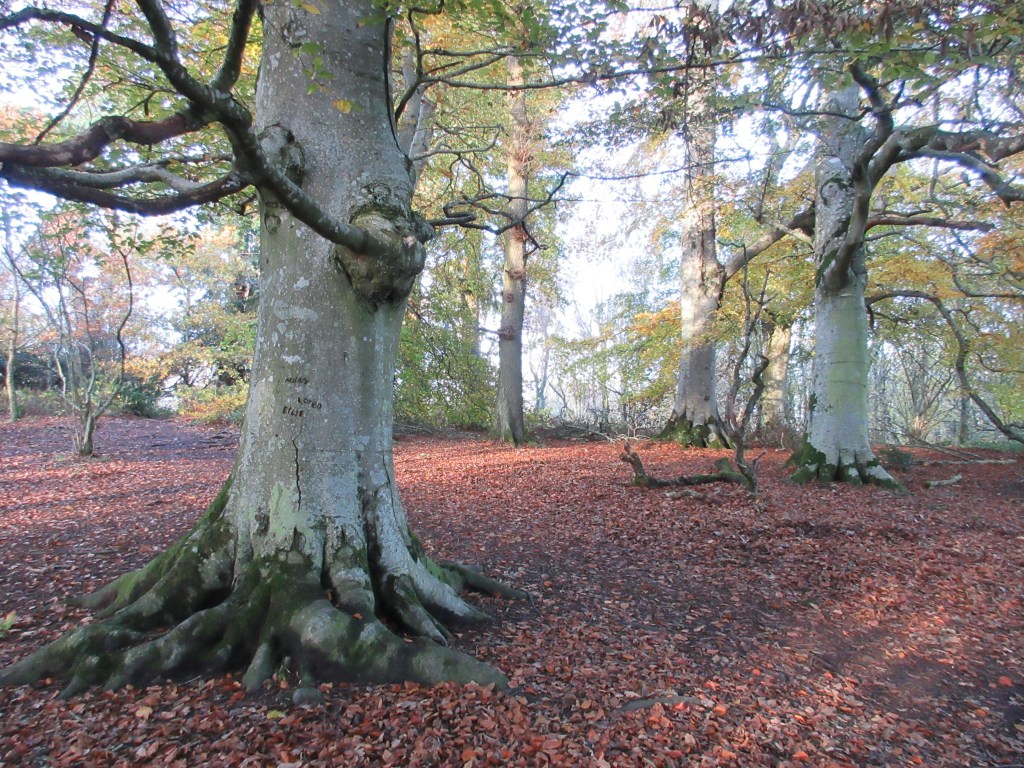
As lichens are not parasitic and instead derive their energy through symbiosis from sunlight, their water from rain and stem flow, and their nutrients from what is absorbed in that water, a common view of lichens is that they do not affect the tree they grow on. But is that really the case? Oak trees can only photosynthesise through their leaves as this is the only part of the tree where chlorophyll is present. However, on entering the Old Wood of Drum, one meets a number of large beech trees, and these beech trees – as is the case for holly – has chlorophyll in their bark as well. Any crustose lichens growing on their trunks will thus block access to sunlight. Interestingly, research has shown that aspen responds to being covered by crustose lichens by producing less chlorophyll in those parts of the trunk that are hidden from sunlight.
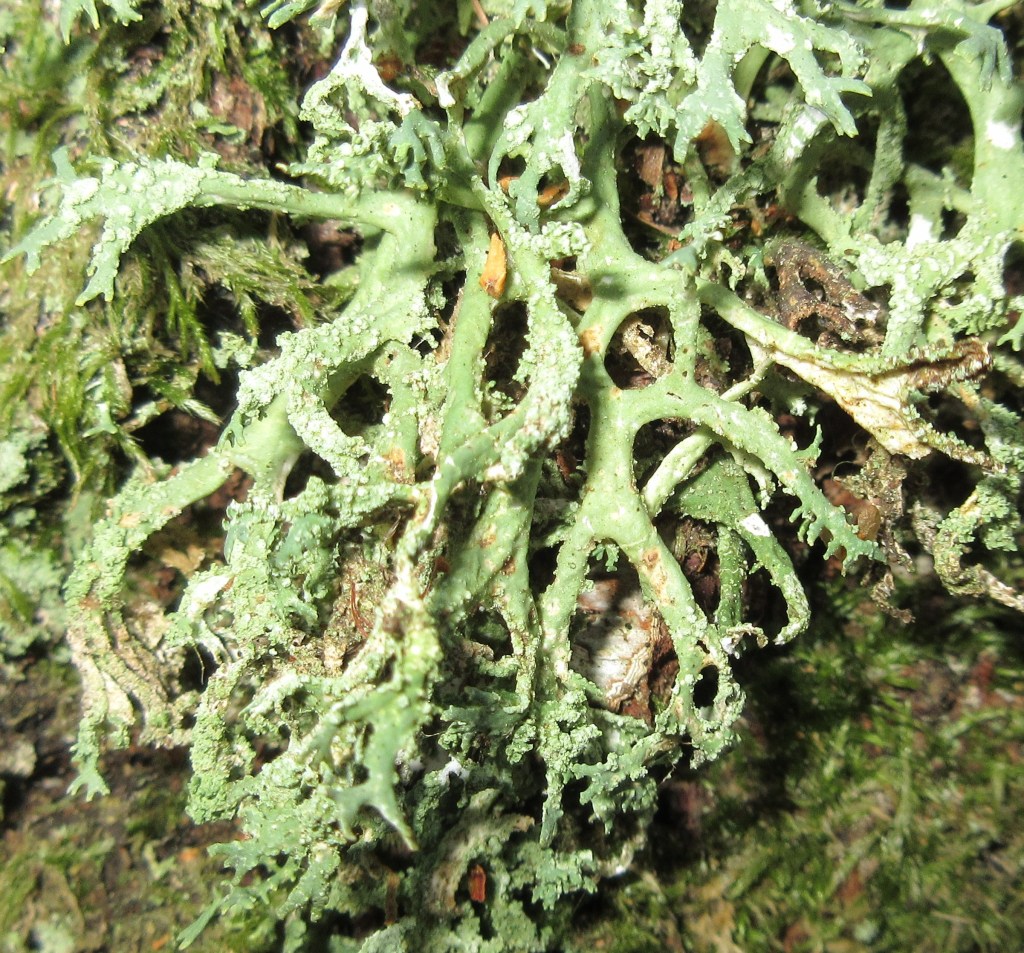
Would it therefore be safe to conclude that lichens do not have any impact on the oak trees they grow on? Research suggests that this may not be true. The hyphae with which lichens anchor to the tree penetrate the bark to different depths. Hypogymnia physodes hyphae on the trunks of some of the Scots pine trees that grow between the veteran oaks, for example, reach the trees’ periderm, whereas the hyphae of Evernia prunastri that grows on some of the deeply furrowed trunks of the oaks themselves penetrate xylem vessels.
Slow growing and immobile, lichen are not able to move away or develop physical features to ward off danger. Instead, they have developed chemical defence strategies. The fungus species in the composite organism produces secondary metabolites. Oak moss, perhaps a rather confusing name for the lichen Evernia prunastri, produces so-called evernic acid and research on silver birch has shown that this evernic acid travels through the tree to the apex of shoots where it inhibits respiration and retards leaf formation. Likewise, the very common Hypogymnia physodes, when covering entire trunks of Scots pine, is able to reduce the vitality of the trees they grow on.
Even though the widely held view is that, because lichens are epiphytes and do therefore not affect the trees they grow on, there is reason to give a more nuanced answer. True, lichens are not parasitic as they do not exploit the tree for energy. Yet, lichens diminish the capacity for photosynthesis for those tree species that have chlorophyll in their bark. What’s more, some of the common epiphytic lichen species in Scotland are known to affect the vitality of the tree through chemicals they produce. There is a small body of research that shows that trees resist lichen growth on their bark. Populus x canadensis, for example, is able to produce bark phenols that inhibit the development of vegetative propagules on the lichen Phycia tenella.
The question I have tried to answer for myself is why lichens diminish the vitality of the trees they grow on as that would ultimately undermine the substratum they anchor to. I have not found any convincing answer in the available literature. Could it be, however, that this allelopathy aims to lighten up the crown so that more light reaches the trunk and there is increased opportunity for photosynthesis by the lichen? As far as I can see the lichen has a delicate balance to strike and increased photosynthesis will have to be weighed up against increased exposure to the dehydrating influences of sun and wind which, in turn, decrease photosynthesis. And as a very slow growing organism which is immobile, the lichen will want to make sure it doesn’t kill the tree it grows on as that will eventually mean it undermines its own existence. The veteran oaks in the Old Wood of Drum, together with their lichen cover, have survived for centuries. Even if some of the lichens growing on them have influenced those oaks, it certainly has not killed them. The argument of the lichens striking a delicate balance may ring true.
The next intakes for the distance learning course Lichens on Trees will be on 23 March and 18 May 2026. For more information on this course, click here.
A version of this article was previously published in ARB MAGAZINE Issue 208 (Spring 2025).
Copyright text and photos Petra Vergunst
 scottishlichens.co.uk