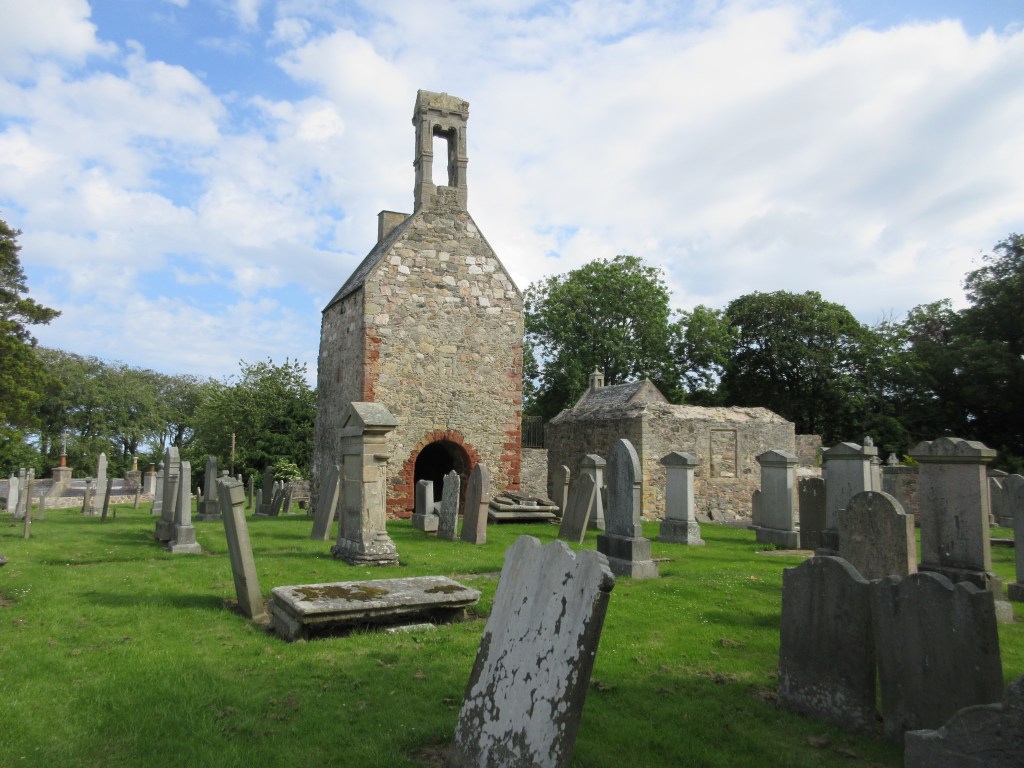
Earlier this month I found myself in the kirkyard at St. Cyrus NNR giving a guided lichen walk. For a moment, we closed our eyes and listened intently. Waves washed ashore and corvids and gulls busied themselves on the cliffs overlooking the reserve. For sure, the coastal setting influences the lichens we find in the kirkyard, but so does the sandstone geology. We had just spoken about open and closed lichen communities and how lichen communities colonising rock can easily be recognised by the many small and similar sized thalli that quickly produce apothecia. Now we are using pieces of string and a measuring tape to gauge the age of some of the lichens on the gravestones.
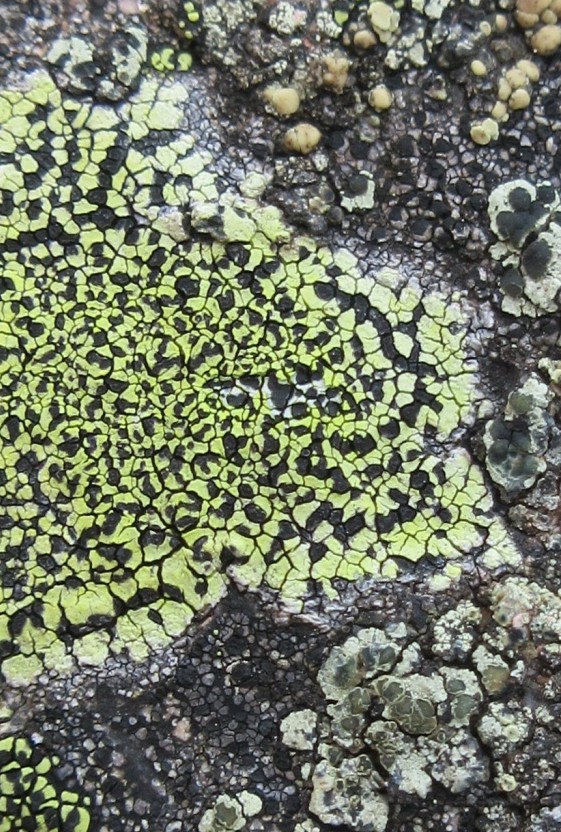
Of course, this activity was just about the crudest way one can estimate the age of lichens, but it did get the message across that the lichens on the gravestones in this kirkyard are old, and that lichens grow slowly. I introduced the idea of lichenometry, the science that uses lichens to date past events. The map lichen Rhizocarpon geographicum, a yellow lichen that is very common on rock throughout in Scotland, is often used for this purpose. Its annual growth has been estimated to average 0.5 to 0.7 mm. Being equally common in Arctic and montane regions, the species has been used to date the retreat of glaciers, the assumption being that it is among the first lichens to colonise the rock that becomes exposed when the ice retreats.
Lichenometry has also been used to date gravestones. A 1983 study by John Innes managed to do so with some precision by comparing the size of crusts on undated gravestones with those on dated gravestones nearby. But this study revealed more. The growth rate of crustose lichens varies along a coast to coast continuum in Scotland, with the highest growth rates found in the wetter west and the smallest growth rates in the east.
Soon, the group started to raise questions. Does meeting another thallus impact the growth rate? Are there factors that impact the health and vitality of lichens? We took out our hand lenses and looked at what happens when lichen thalli meet and lichen communities become closed. Depending on the species that meet and the vitality of the crusts, one lichen can overgrow another, or two thalli can come to a standoff, with some species reinforcing their margins by thickening at the zone of interaction. Needless to say, conquering another lichen and creating thallus in defence take energy, and that will slow down growth.
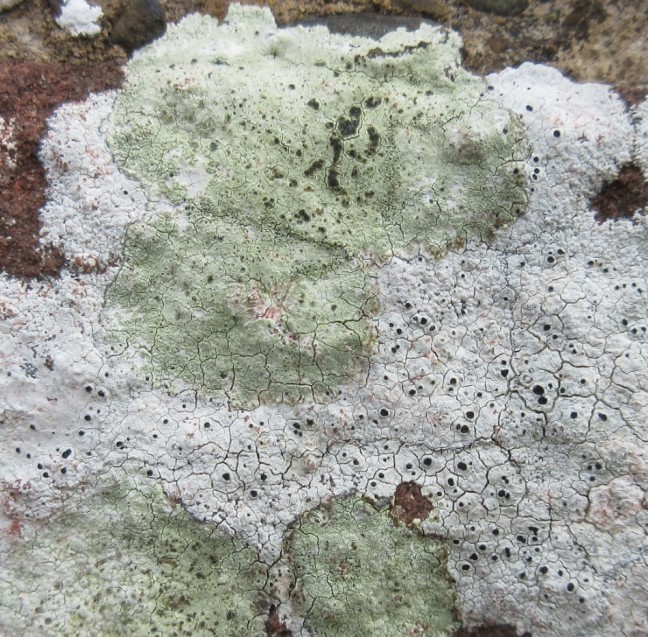
Lichen herbivory is likely to affect to vitality of lichens as well. It is very common to find lichen crusts that appear entirely flattened or that systematically display holes where one would expect apothecia. Sometimes I find grubs like springtails at work, sometimes I find the characteristic zigzag trails that slugs and snails leave behind when they scrape the thallus with their radula. Many invertebrates go straight for the apothecia. Lichenicolous lichens and fungi will affect the growth rate of lichens as well. We notice how thalli of Lecanora sulphurea often overgrow those of Tephromela atra or Lecanora gangaleoides, and discover how their spores ‘borrow’ some of the green algae of their host so as to be able to quickly establish a new lichen thallus. Lichenicolous fungi, tiny non-lichenised fungi that parasitise lichens, are an even more common phenomenon, and the greyed apothecia of Lecanora rupicola and the discolorisation of the apothecia of many other Lecanora species are easily spotted.
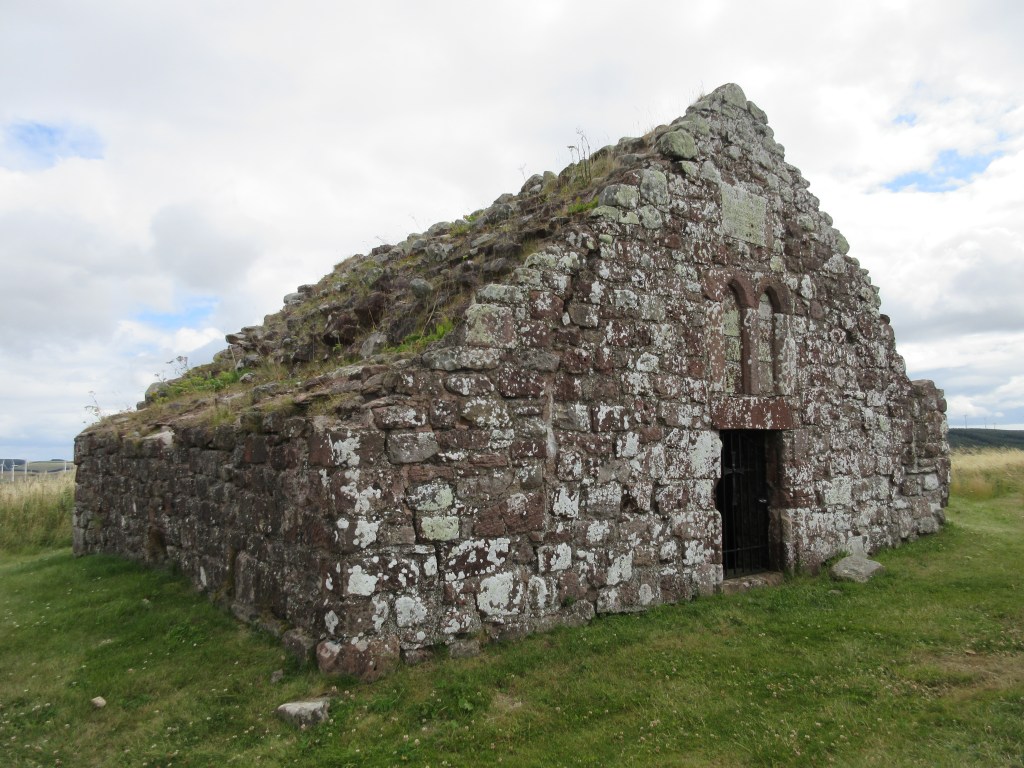
There is something about lichens on stone monuments that keeps drawing me in. Be it recumbent stone circles, ruined farmsteads, gravestones or drystone dykes, the lichens on them are a conduit through which I can tell stories about our environment. And these are stories I love to tell.
The course Lichens on Stone is an introduction to lichens that grow on archaeological and historical monuments, that are found in churchyards and on drystone dykes. Lichen growth and lichenometry are among the themes covered in this distance learning course. The course will start Monday 9 November. For more information, please see the Eventbrite page.
P. S.: Busy guiding the walk, I forgot to take photographs and this blog is thus illustrated with photos from other churchyards.
Copyright text and images Petra Vergunst

