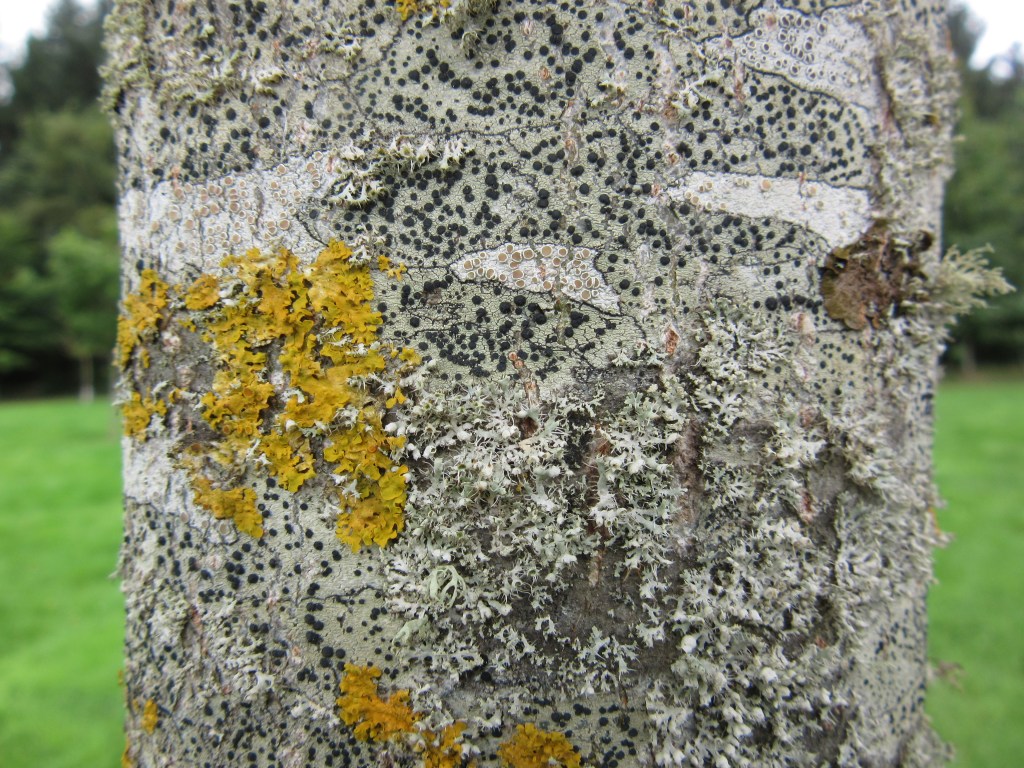
Mostly, the presence of lichens is something I take for granted, but every now and again I find myself wonder how lichens reached a certain tree or rock. Take that young shoot of dogrose, perhaps a year or two old, that is covered in an intricate mosaic of Lecanora chlarotera, Lecidella elaeochroma and Arthonia radiata. Lichens are known to be slow-growing, so how come these lichens managed to colonise it this quickly? And then there was this slated wall of a recently built shelter at the RSPB reserve at Fowlsheugh (VC91) that was covered in small, similarly-sized lichens. These patches were beautifully circular, as if the deformation resulting from dying back and competition between adjacent specimen had yet to set in. As the thalli were often still not fully developed, the perfectly shaped and mature apothecia stood out.
So how come lichens manage to colonise new substrata this quickly? The answer is spores. Though invisible with the naked eye, the air is laden with spores and on reaching a bare substratum, the spores may attach and a lichen may start to grow. If only it was this simple! To understand the answer more fully, we need understand the conditions under which a lichen will develop from a spore, and to appreciate that we need to be able to tell what lichens are and how they disperse.
Like plants or bryophytes, you would expect a lichen to be a single organism, but lichens are in fact a symbiosis of two organisms. On the one hand, there is a fungus species, one the other, there is either a green alga or cyanobacterium. Lending the lichen its name, the fungus species is unique to each lichen and can usually only grow in the lichen symbiosis. It is a so-called lichenised fungus. The green algae and cyanobacterium have more options and can often enter a symbiosis with more than one lichen-forming fungus species or even be free-living. The green alga or cyanobacterium is responsible for photosynthesis (and therefore called a photobiont) and delivers sugars to the fungus that provides protection in return.
Of course, I am cutting corners in the above description, but the point to take from it is that in order to establish itself as a lichen, the lichen-forming fungus will need to find the right green alga or cyanobacterium to enter a symbiosis with. Lichens have therefore developed two strategies to reproduce. The safest route is that of asexual reproduction. A lichen thus produces structures like isidia and soralia that contain both fungal and photobiont cells so it can readily develop a new specimen if it arrives on a bare substratum under the right conditions. The disadvantage is, however, that this type of reproduction is clonal and does not involve genetic renewal. (Research is currently exploring whether there is some form of genetic reconnection in asexual reproduction after all.) Structures like isidia and soralia are also relatively heavy and will often disperse only short distances, establishing itself within a few metres of its source. To ensure genetic renewal and longer-distance dispersal, and thus to colonise a new growth of dogrose and the wall of a recently built shelter, lichens may reproduce through the production of spores. Lightweight in comparison, spores may be picked up in air currents which enable them to reach new areas. This form of sexual reproduction is risky. Spores only contain fungal cells and when they arrive on bare substratum under suitable conditions, they will have to find the right photobiont partner, a process which is called re-lichenisation.
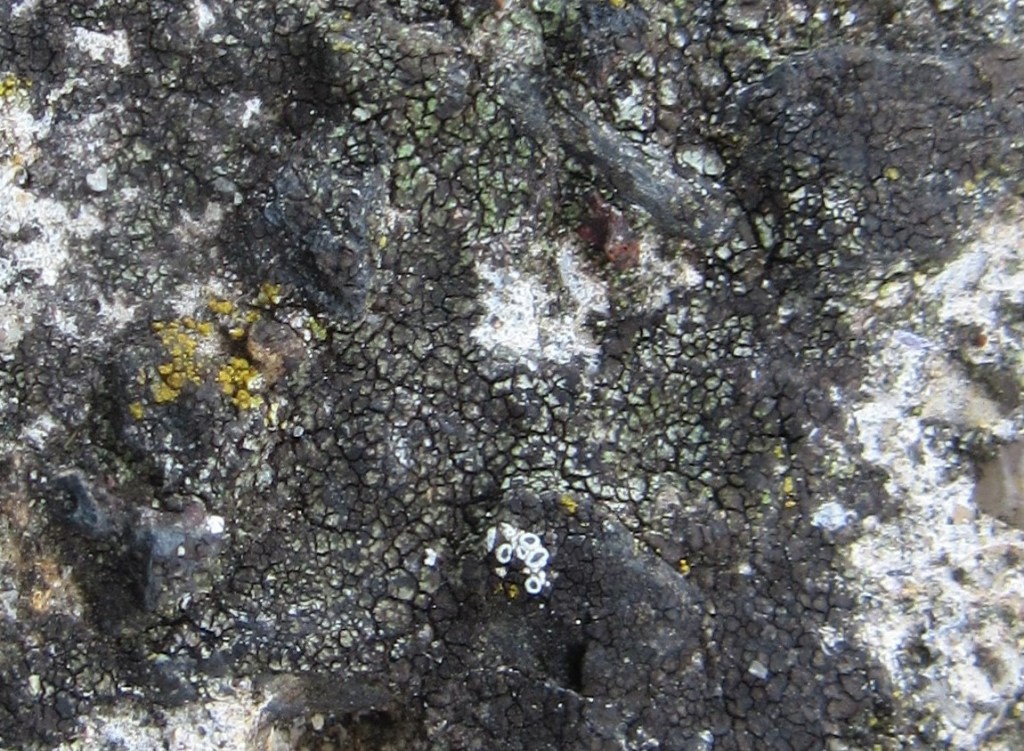
Some lichen species reproduce mainly through isidia and soralia, other lichens mainly through spores, while there is also a group of lichens that do a bit of both, sometimes in response to environmental conditions. Re-lichenisation is risky, and a fungal spore will often die if it hasn’t found a suitable partner within a certain timeframe. Some lichens that reproduce through spores have, however, found an answer to this: parasitism. The greenish crustose lichen Lecanora sulphurea may, for example, establish itself on top of the crusts of Tephromela atra and borrow some of that species’ photobiont. For similar reasons, Placopyrenium fuscellum is always found on Verrucaria nigrescens. Something similar has been observed in foliose lichens. When the spores of Xanthoria parietina, for example, attach to Physcia tenella, they borrow some of the latter species’ photobiont which allows them to quickly establish themselves. Though the large lobes of Xanthoria parietina may overshadow and eventually kill the host Physcia tenella, on willow in the dune slacks at Balmedie (VC92) I found the more bushy Physcia tenella triumphant as it managed tower over the much flat lobes of Xanthoria parietina. As David Richardson wrote: there’s indeed war in the world of lichens!
So how come lichens are able to colonise new substrata so quickly? Truth is that it is only certain species that are able to do so, that is, ubiquitous species that produce ample spores and that are not choosy as to their environmental conditions. The typical trio of species that, in North East Scotland, colonises bark consists of Lecanora chlarotera, Lecidella elaeochroma and Arthonia radiata. The thalli of these crusts are covered in spore-bearing apothecia. Not only do these apothecia allow them to arrive at that dogrose shoot quickly, it will also allow them to move on from there.
The distance learning course Lichens on Trees looks in more detail at the colonisation and growth of lichens.
Sources
Dobson, F. S., 2018. Lichens. An Illustrated Guide to the British and Irish Species. Seventh edition. Richmond Publishing.
Gilbert, O., 2000. Lichens. HarperCollins, London.
Richardson, D. H. S., 1999. War in the world of lichens: parasitism and symbiosis as exemplified by lichens and lichenicolous fungi. Mycological Research 103: 641-650.
Copyright text and images Petra Vergunst
 scottishlichens.co.uk
One thought on “New beginnings: lichen colonisation”