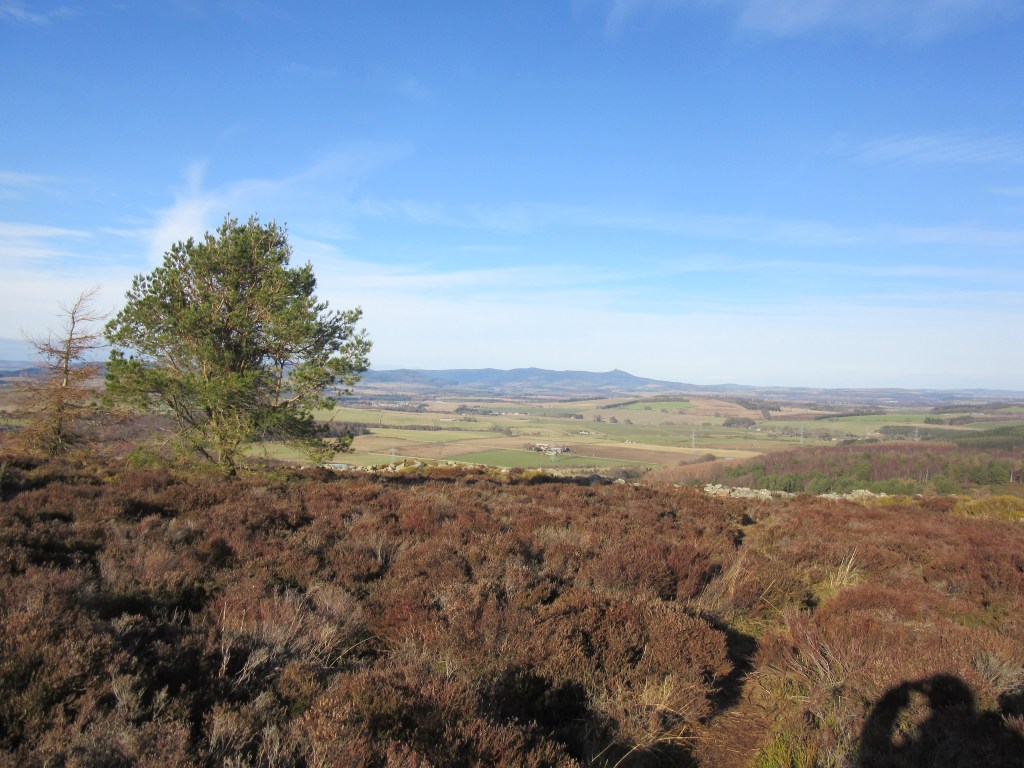
A ‘commanding view’ is the phrase the RCAHMS uses in their book In the Shadow of Bennachie to describe the hillforts of Donside. There is something captivating about visiting these hillforts. The expansive views, often across vast areas of lower lying farmland, and the appreciation that these hilltops were once not the destination for a leisurely Sunday afternoon stroll but viewpoints from which the surrounding land was scanned for possible intruders, certainly draws me in. Northeast Scotland is home to quite a few of these fortifications, and I’m gradually ticking them off.

The one closest to home, the Barmekin of Echt (west of Westhill, Aberdeenshire) has been a real eye-opener. On clear days this hillfort, rising no more than one hundred meters above the surrounding arable land and pastures, gives views as far as the North Sea. The path to the top winds through gorse, and then a combination of bracken, blaeberrry and wide-crowned Scots pines. The hillfort itself, several large, circular ramparts of exposed boulders, encloses an area of dry heath. The views from the top are commanding, but so are the lichen species I found on these fortifications. Indeed, there are the likes of Rhizocarpon geographicum, Lecanora polytropa, Acarospora fuscata and Umbilicaria polyphylla that also feature on dykes in the surrounding farmland, but there are also crusts like Ophioparma ventosa and Fuscidia cyathoides, and a galore of foliose and fruticose species including Sphaerophorus globosus, Cetraria aculeata and Cornicularia normoerica. These species I would not usually find on dykes and they seem to have more affinity with exposed acidic rock in the uplands, perhaps even scree slopes.

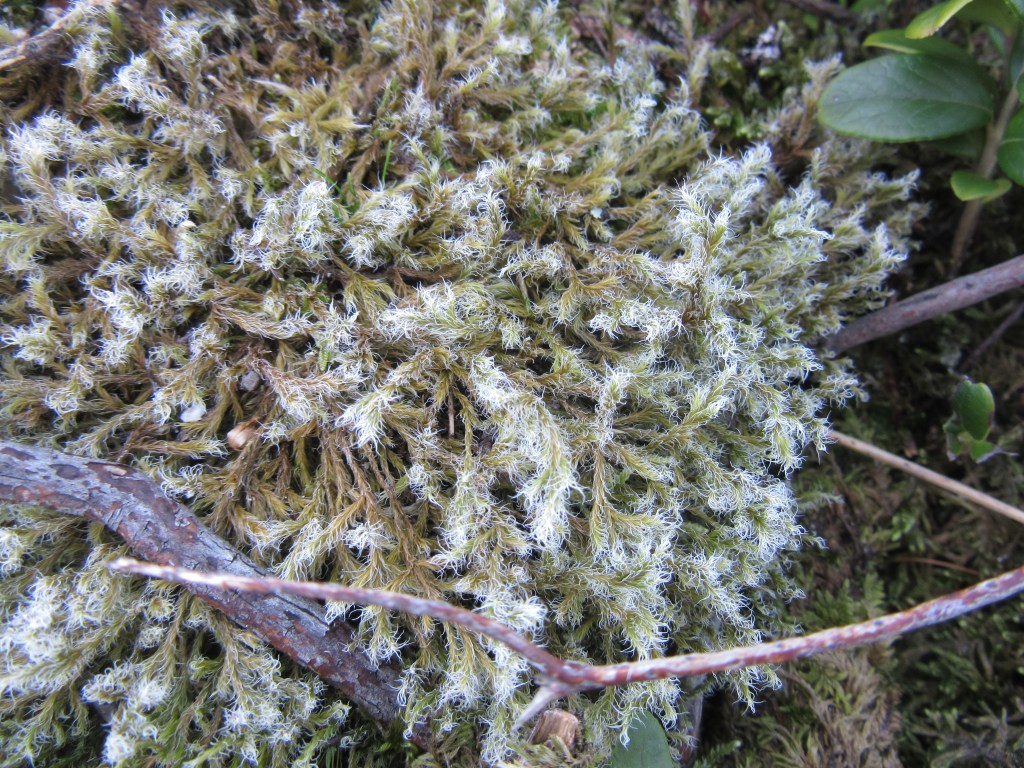
That this hillfort offers opportunities for lichen species that favour exposed acidic rock in upland situations was further emphasised when I returned recently to explore the bryophyte flora. Though some of the weft-forming bryophytes such as the ubiquitous Hylocomium splendens and Hypnum jutlandicum that grew through the heather and blaeberry sometimes encroached onto the rocks, on the top of the boulders there was only the occasional patch of Racomitrium lanuginosum, a sprawling moss with very long and wavy hair points that help create a layer of relatively still air directly around the moss to slow down dehydration by wind and sun. This may well be the adaptation most frequently seen in mosses that grow in exposed upland conditions. Every now and again there would also be a patch of moss in the slightly damper junctures between rocks, but liverworts only grew in the shelter of deep crevices between large boulders. On these fortifications I was seeing the exposed upland conditions played out as attempts by mosses and liverworts to stay as hydrated as possible in the face of drying winds and sun. Lichens seemed by far the group better adapted to these conditions.
Exactly how special the lichen flora at the Barmekin of Echt is became clear when I visited the twinned hillforts at the Brown and White Caterthun near Edzell in Angus later last summer. On the Brown Caterthun the fortifications were covered in turf, the grass and heather smothering any opportunity for saxicolous lichens to gain a foothold. The fortifications on the White Caterthun were exposed and appeared slightly less extensive than those of the Barmekin of Echt, but perhaps the most significant differences were that the boulders used to construct these fortifications were smaller, perhaps also flatter, and that the fortifications themselves were hardly elevated above the level of the surrounding vegetation. I did find some of the lichens I had also seen at the Barmekin of Echt, such as Ophioparma ventosa and Pertusaria corallina, and in a small area with larger boulders on the side I also found species such as Umbilicaria cylindrica, Stereocaulon vesuvianum and Ochrolechia androgyna not seen at the Barmekin of Echt. Yet, it felt as if these exposed-upland species were less abundant. Location in the landscape and geology could explain some of these differences, but the size and shape of the boulders will have played a role as well. The larger and more rounded boulders at the Barmekin of Echt provided more niches for lichens by having exposed tops, more or less humid flanks, and crevices where boulders meet. This richness in micro-environments meant a more abundant and diverse lichen flora.


Ever since my visit last summer, I have wondered how it is possible that the ramparts at the Barmekin of Echt host a number of lichen species that are not found in the immediate surrounding landscape. The very essence of hillforts is that they are situated on hills from which the surrounding landscape can be scanned. This isolation makes the question how lichen species of exposed upland conditions may have reached the hillfort more pertinent. When I returned to the Barmekin of Echt recently, I was struck by the granite tor of Mither Tap on the skyline. Not only is Mither Tap one of the most famous hillforts in Aberdeenshire, as the summit of the Bennachie range Mither Tap is also home to similar upland species as the ones I found on the Barmekin of Echt. Spores of lichens are carried on air currents. It could well be that there has been an exchange of spore-dispersed lichens between the hillforts with exposed fortifications (and hilltops with similar exposed rock) in the northeast of Scotland.

As I descended through the bracken and blaeberry and reached my familiar territory of Orthotrichum affine cushions on birch at the foot of the hill I was thinking about the relation between archaeology and the study of lichens and bryophytes. Had it not been for my interest in lichens, liverworts and mosses, I would not have appreciated the subtle, and not so subtle, differences in the way in which the hillforts like the Barmekin of Echt and the Brown and White Caterthun were constructed and are now presenting themselves. What further observations would arise if I continued to use lichens and bryophytes as a lens to look at the nature of hillforts more widely?
Copyright text and images Petra Vergunst
 scottishlichens.co.uk
One thought on “A commanding view: hillforts through the lens of lichens and bryophytes”