
Late last summer I decided to learn more about churchyard lichens so I visited a few a stone throw from my home in North-East Scotland and had a trip to some rural and coastal churchyards in Kincardineshire. Given the clear descriptions of churchyard assemblages in Oliver Gilbert’s book Lichens and the arrangement of keys by substratum in Frank Dobson’s Field Key to Common Churchyard Lichens, I expected this to be a relatively straightforward bit of lichen recording, and a welcome let-up after the complexities of spending the summer lichen recording in woodlands and hills. The identification of lichens found in churchyards, however, turned out to be just as puzzling. On the one hand, I was hardly able to find the types of gravestones and memorials as described by Gilbert, on the other hand, Dobson’s key included many species not found in Scotland and had omitted some of the species I did find. It felt like I needed to create my own baseline that would give me insight in what to expect when entering a churchyard somewhere in North-East Scotland, and one that would allow me to distinguish the ordinary from the extraordinary. As I was unable to find any churchyard lichen records for Donside (VC92), and Donside being an area where I had done very little recording to date, I set myself the challenge to visit ten churchyards between the mouth and the source of the river Don.
Though the lichen assemblages found in churchyards differed a lot between the different reaches of the river, the tradition of stones used was quite consistent. Usually, the majority of the gravestones – and especially the more modern ones – were made of granite with a polished side that was usually very slow in acquiring lichen cover, and a rough side that would be covered in species like Melanelixia fuliginosa, Parmelia saxatilis, Parmelia sulcata, Hypogymnia physodes, Rhizocarpon geographicum, Rhizocarpon reductum, Lecidea lithophila, Lecanora polytropa, Acarospora fuscata, and other species that are often found on siliceous rock. Especially the older churchyards would also have a handful of simple sandstone gravestones with a heavy cover of species including Ochrolechia parella, Tephromela atra and Lecanora rupicola. Only once or twice I found another type of stone, and I was unable to find the Lecanora crenulata that I so desperately wanted to find after seeing it on a marble memorial in my local churchyard.
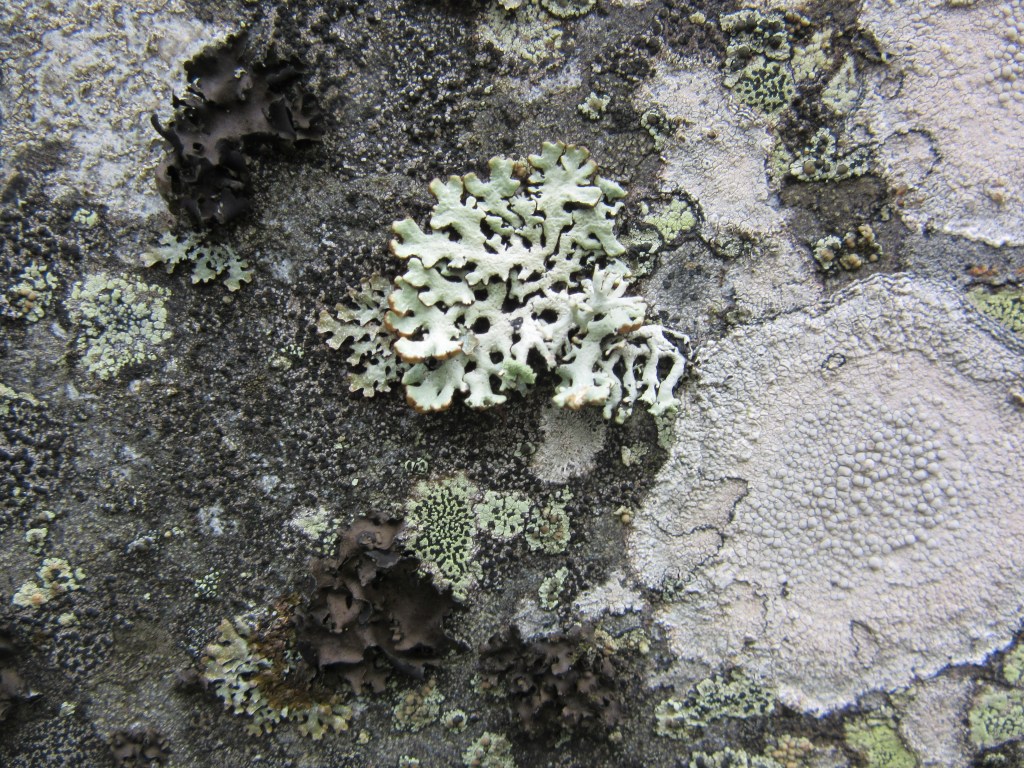
On approaching a churchyard, I usually adopted a more or less systematic approach, starting with the boundary wall of the churchyard, including any metal gates, before actually entering. Within the churchyard itself I found it worth keeping an eye out for Peltigera membranacea and Peltigera hymenina between mosses and in the grass. Quite often some of the large trees in the churchyard have also shed branches which are well worth picking up. In Strathdon a branch offered me a particularly nice specimen of Melanohalea exasperata. After that, I usually looked at a selection of gravestones in different parts of the churchyard and made sure I included examples of both granite and sandstone memorials as well as erect and recumbent stones. Though Gilbert suggests that the churches themselves are often the most lichen-rich, the walls of the granite churches in Donside are certainly less so. The mortar between the stones, however, did usually provide a nice assemblage of Lecanora albescens, Lecanora dispersa and Caloplaca holocarpa.
After starting my survey near the mouth of the Don in Aberdeen, I passed through farmland before gradually working my way into the hills near Strathdon. As I was following the river Don upstream the churchyard assemblages underwent significant changes. Historic sulphur dioxide pollution in Aberdeen, and to a lesser extent in Kintore, meant the almost complete absence of fruticose and foliose species and the crustose species looked like stains that lacked the apothecia, soredia or isidia that would help name them. Moving through farmland near Dyce and Hatton of Fintray, I found typical nitrogen indicators like Candelariella vitellina and Candelariella aurella in particular good shape. I had to wait until Monymusk before finding good displays of typical upland species like Xanthoparmelia mougeotii and the odd Tephromela grumosa, Miriquidica leucophaea and Protoparmelia badia. By the time I had arrived in Strathdon, however, the gravestones were covered in rich assemblages of fruticose and foliose species, including Bryoria fuscescens, Usnea subfloridana, Pseudevernia furfuracea, Tuckermannopsis chlorophylla and Umbilicaria polyphylla. Dobson’s churchyard key is arranged on basis of the relative acidity of the substratum and Gilbert similarly arranges his discussion of churchyard lichen assemblages on basis of the properties of the substratum. Following the river upstream I felt that, though a number of species were found in each churchyard, significant parts of the assemblages (and the relative abundance of these species) were often determined by not the properties of the rock, but by the gradient between coastal lowland to upland and (linked) air quality.
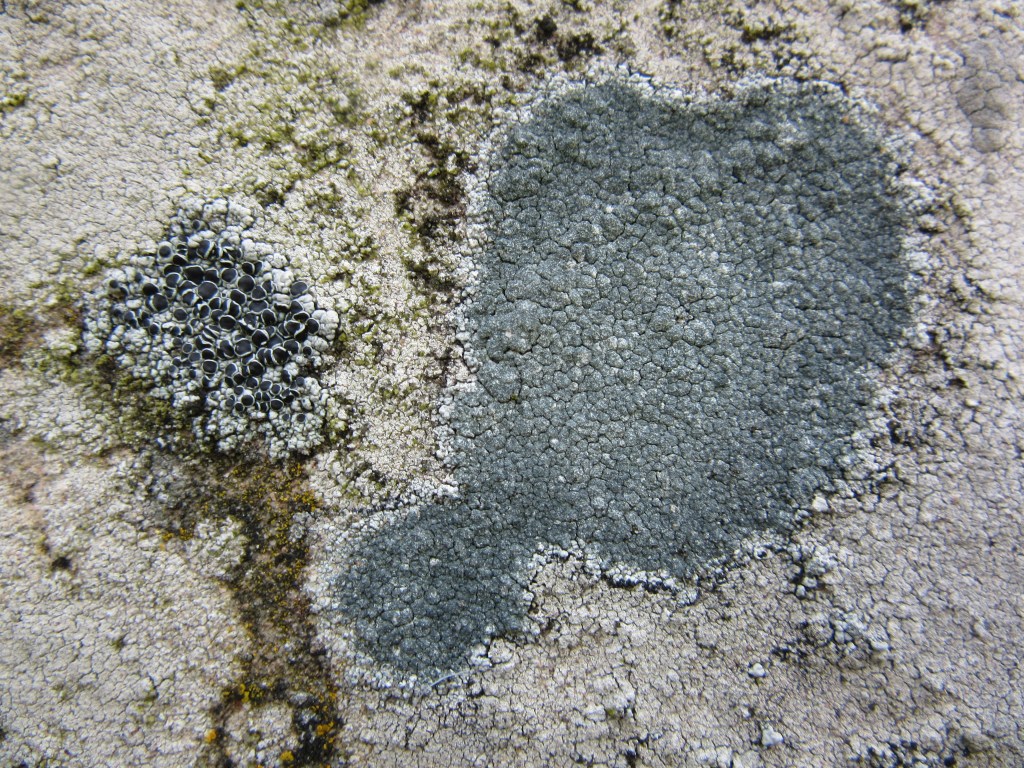
So to what extent are churchyard lichen assemblages unique? Especially in upland settings the fruticose and foliose lichens found were species readily present on dykes in the surrounding landscape. Further downstream, in more intensively farmed areas, the species were more unique to churchyards. Especially the sandstone assemblages had strong affiliations with coastal assemblages, suggesting the influence of the slightly more nutrient-rich substratum and well as nutrient-enrichment. If lichens have been left to grow on gravestones over the centuries the stones have likely also accumulated some dust, which may act as a form of nutrient-enrichment and explains the resemblance of some churchyard assemblages with those along the coast where saline air provides a form a natural nutrient-enrichment.
As they are often left untouched for centuries, it is worth visiting churchyards to find some interesting lichen species. With the boundary wall, church, gravestones, mosses and grass often having quite specific assemblages, the identification of the most common species is often a choice between a limited number of species. Members of The British Lichen Society have done a stellar job in surveying a significant proportion of churchyards in England, but those in Scotland have never received this level of attention. I will certainly continue to survey churchyards in my area. Anybody join me in this effort?
Click here for a picture gallery of churchyard lichens.
Sources
Dobson, F. S., 2013. A Field Key to Common Churchyard Lichens.
Gilbert, O., 2000. Lichens. HarperCollins, London.
Copyright text and images Petra Vergunst
 scottishlichens.co.uk
One thought on “Churchyard lichens along the Don”